
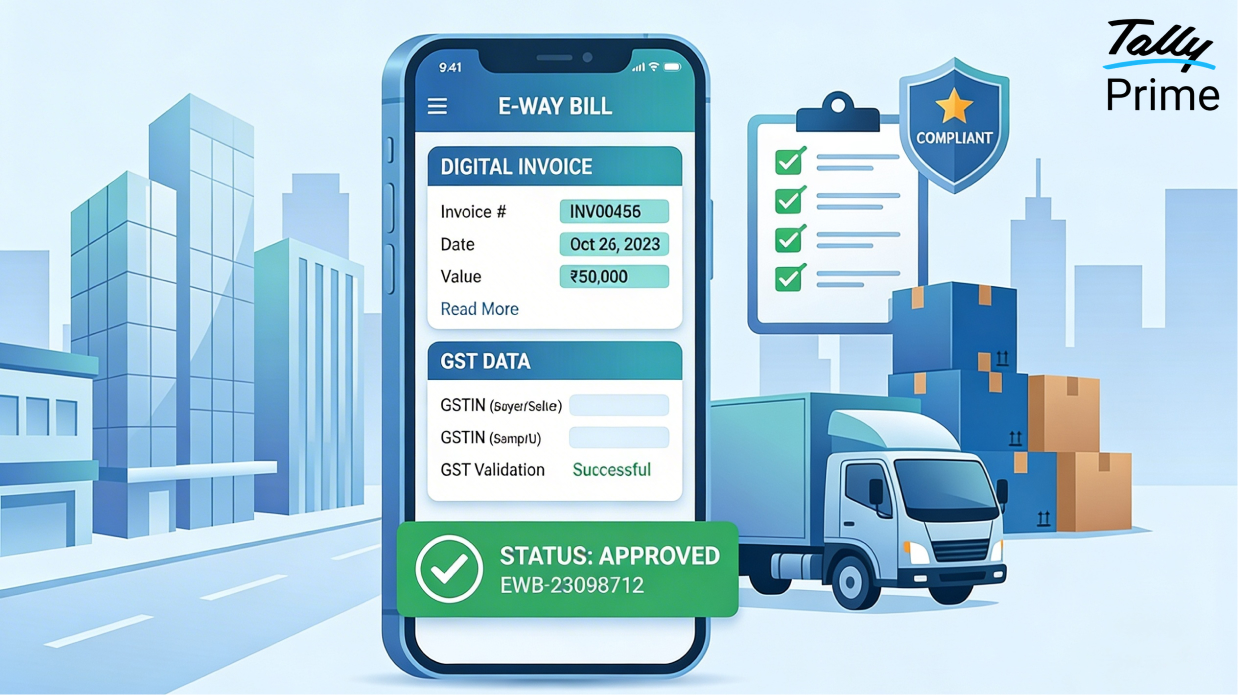
In the GST regime, compliance is not just a legal requirement—it is a critical part of smooth business operations. One of the most important components of GST compliance is the E-Way Bill system, which regulates the movement of goods across India.
Many businesses, especially small and medium enterprises, often struggle with E-Way Bill compliance due to lack of clarity, improper processes, or simple human errors. These mistakes can lead to heavy penalties, shipment delays, and unnecessary legal complications.
However, the good news is that E-Way Bill compliance does not have to be complicated. By understanding the correct process and following best practices, businesses can easily avoid penalties and ensure seamless transportation of goods.
What Is an E-Way Bill?
An E-Way Bill (Electronic Way Bill) is a document required for the movement of goods under GST when the value exceeds the prescribed limit. It is generated electronically on the GST Portal before goods are transported.
The E-Way Bill includes important details such as consignor and consignee information, invoice details, description and value of goods, and transporter details. This system helps authorities monitor the movement of goods and ensures tax compliance.
Why E-Way Bill Compliance Is Important
E-Way Bill compliance is essential for maintaining smooth business operations and avoiding legal risks.
Failure to comply can result in penalties, detention of goods, delivery delays, and reputational damage. Businesses that follow proper compliance processes can ensure uninterrupted logistics and build trust with customers and authorities.
When Is an E-Way Bill Required?
An E-Way Bill is generally required when the value of goods exceeds ₹50,000.
It is applicable in cases such as movement of goods for supply, return, or job work, and for both inter-state and intra-state transportation depending on rules. It is required regardless of the mode of transport, whether by road, rail, air, or ship.
Understanding these conditions is crucial to avoid unintentional non-compliance.
Common Mistakes That Lead to Penalties
1. Not Generating E-Way Bill on Time
One of the most common mistakes is failing to generate the E-Way Bill before the movement of goods begins.
2. Incorrect Information
Entering wrong details such as invoice number, GSTIN, or vehicle number can lead to compliance issues.
3. Expired E-Way Bills
Each E-Way Bill has a validity period. Transporting goods with an expired E-Way Bill is a violation.
4. Mismatch Between Documents
Differences between invoice details and E-Way Bill data can trigger penalties.
5. Ignoring Updates or Changes
Not updating vehicle details during transit can also result in non-compliance.
The Right Process for E-Way Bill Compliance
Step-by-Step Compliance Approach
To avoid penalties, businesses must follow a structured and accurate process.
First, ensure that all invoice details are correct and complete. Before dispatching goods, generate the E-Way Bill through the GST Portal by entering accurate information.
Once generated, verify all details carefully, including transporter information and vehicle number. During transit, ensure that the E-Way Bill is accessible, either digitally or as a printed copy.
If there are any changes during transportation, such as vehicle replacement, update the details immediately on the portal. Additionally, always monitor the validity period to avoid expiry during transit.
Following this structured approach ensures compliance and eliminates the risk of penalties.
How to Avoid E-Way Bill Penalties
Best Practices for Businesses
Businesses can simplify compliance by adopting a few best practices:
- Always generate E-Way Bills before dispatch
- Double-check all entered details
- Train staff on GST compliance procedures
- Use automation tools to reduce manual errors
- Track validity and update details when required
These practices help businesses stay compliant and avoid unnecessary risks.
Role of Technology in Simplifying Compliance
Technology plays a major role in making E-Way Bill compliance easier and more accurate.
Using accounting and GST software like TallyPrime allows businesses to:
- Generate E-Way Bills directly from invoices
- Reduce manual data entry errors
- Maintain accurate records
- Ensure seamless GST compliance
Automation not only saves time but also significantly reduces the chances of penalties.
Benefits of Proper E-Way Bill Compliance
Following the correct compliance process offers several advantages:
- Smooth movement of goods without delays
- Avoidance of penalties and legal issues
- Improved operational efficiency
- Better documentation and record-keeping
- Enhanced business credibility
Compliance is not just about avoiding penalties—it is about building a reliable and efficient business system.
Challenges Businesses Face in E-Way Bill Compliance
Despite its importance, businesses often face challenges such as:
- Lack of awareness about rules
- Frequent changes in regulations
- Manual errors in data entry
- Difficulty in tracking validity
These challenges can be overcome with proper training, systems, and tools.
Conclusion
E-Way Bill compliance is a vital part of GST regulations, but it does not have to be complex. By understanding the rules and following the right process, businesses can ensure smooth transportation of goods without facing penalties.
The key lies in accuracy, timely action, and the use of proper systems. Businesses that adopt a structured approach to E-Way Bill compliance not only avoid legal issues but also improve their overall efficiency.
2. When is an E-Way Bill required?
An E-Way Bill is usually required when goods worth more than ₹50,000 are transported. In some cases, it may also be needed below this limit depending on GST rules and transport conditions.
3. What happens if the E-Way Bill is not generated?
Failure to generate an E-Way Bill can lead to penalties, fines, delays, and detention of goods or vehicles during transit. It may also create compliance issues for the business.
4. Can E-Way Bill be updated?
Yes, some details like vehicle number, transporter information, or mode of transport can be updated after generation. Main invoice details usually cannot be changed once submitted.
5. How can businesses avoid penalties?
Businesses can avoid penalties by generating E-Way Bills on time, entering correct details, checking validity dates, and using software tools to reduce errors and improve compliance.